


The “Third Degree” Thirties in New Orleans
On Jan. 15, 1941, 39-year-old Black laborer Wilmer Smith became the fifth known individual to die at the hands of William Grosch, a 48-year-old white detective with the New Orleans Police Department. In a practice that District Attorney Eugene Stanley called in 1933 “the barbarous third degree,” the New Orleans police drew national attention for the frequency with which they employed force and brutality in the 1930s.
To understand the death of Wilmer Smith is to contend with the decade of violence that preceded his killing. Records for Grosch's early victims fall outside the purview of the Civil Rights Cold Case Records Review Board, which focuses on the period between 1940 and 1979, but their stories are part of Smith’s.
William Grosch became a detective in 1931, one year after his younger brother, John Grosch, was promoted to the post of chief of detectives. Just seven months into his role, William Grosch faced a jury for his actions. In January 1932, 21-year-old Thomas Paddock and 22-year-old Lawrence Werner, both white, testified that Grosch was one of three policemen who brought them to the “show-up” room at the 12th precinct and beat them with revolvers and blackjacks until they confessed to a robbery. The criminal court judge determined that Paddock and Werner’s confessions were made freely and allowed them to be entered as evidence. A jury deliberated for 15 minutes before finding both Paddock and Werner guilty of assault and robbery.
On March 9, 1932, Grosch was one of more than 100 officers who responded to the 12th precinct jail following the killing of three white police officers and a Black trusty. According to the Baltimore Afro-American, 28-year-old Black laborer Percy Thompson wrested control of an officer's gun after he had “been beaten unmercifully with a rubber hose by the slain officers.” The New Orleans Item noted that, of the many officers on the scene, it was Grosch — and two others — who “closed in” on Thompson inside the jail. Once captured, Thompson was transported to the hospital for treatment. In the police car on the ride back from the hospital to the jail, Detective Victor Swanson shot and killed Thompson.
Two months after Thompson’s death, William Grosch and his partner, Detective William Vandervoort, were accused of beating a man to death. On May 10, 1932, Grosch and Vandervoort responded to a call reporting suspicious activity, where they arrested 32-year-old Ross Palumbo, a white Italian immigrant, and his companion, Samuel Mistretta. The Times-Picayune reported that Palumbo and Mistretta were arrested and then transferred from the 1st precinct to the 12th precinct jail. According to the paper, Charity Hospital records indicated that police called for an ambulance about an hour later. When the ambulance arrived, medical personnel pronounced Palumbo dead.
Mistretta, according to the Times-Picayune, told the district attorney that he and Palumbo were separated at the 1st precinct station and confined to separate cells. He heard “screams and sounds of blows” coming from Palumbo’s cell. Dr. George F. Roeling’s coroner’s report reflected that Palumbo died due to “hemorrhage and shock resulting from traumatic rupture of the mesenteric blood vessel.” Roeling said that Palumbo had bruises on his neck and abdomen that “must have been inflicted within a very few hours before the man’s death because they were reddish at the time of the examination and had not had time to turn purple.” Roeling also noted there were “severe brush burns” on Palumbo’s right elbow and his hands “were extremely dirty as though they had been dragged along a floor.”
The Times-Picayune reported on May 11 that Mistretta identified both Grosch and Vandervoort at the district attorney’s office, selecting the two detectives "from a group of 15 men, all in plain clothes.” Grosch and Vandervoort denied the beating accusations, and Grosch suggested that Palumbo had suffered a fall earlier in the night, prior to his arrest. Both detectives were suspended.
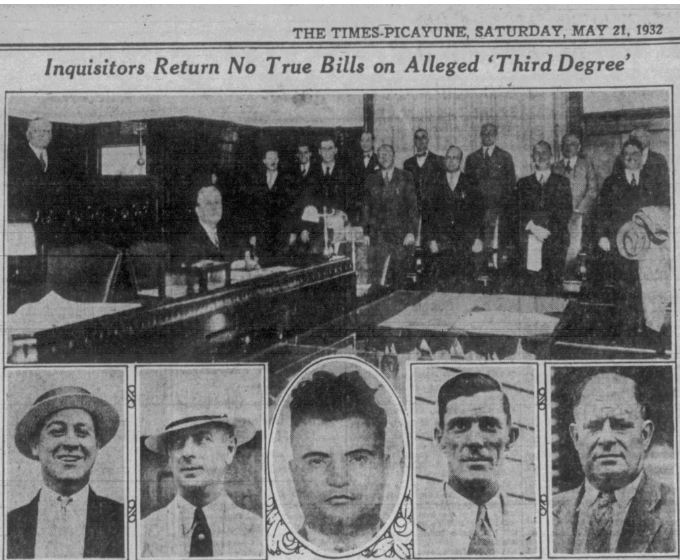
Nine days later, on May 20, an Orleans Parish grand jury convened and declined to indict Grosch and Vandervoort. Superintendent of Police George Reyer immediately reinstated both detectives following the grand jury’s determination.
Palumbo’s widow, Mary Tusa, filed suit for damages two years after her husband’s death. She sought $25,000 for herself and $25,000 for her son, six-year-old Anthony Palumbo. According to the Times-Picayune, Mistretta testified that the night of the arrest he could hear Palumbo “crying for his life” and “begging the officers not to kill him.” Following two hours of deliberation, the jury found in favor of the detectives. Tusa’s attorney stated that he would appeal, but the status of any further legal action in the case is unknown.
Almost exactly a year after Palumbo’s killing, Grosch shot and killed 24-year-old white New Orleans native George Roesch. On May 16, 1933, Grosch and his partner, William Weber, chased Roesch for several blocks following a gas station robbery. Grosch said later that he saw a “glint of steel” and fired at Roesch. The Times-Picayune reported that Roesch died instantly. According to his obituary and federal census records, Roesch was married to 23-year-old Nora Hamilton and had a five-year-old son at the time of his death. In August, the Alexandria Town Talk reported that a grand jury declined to indict Grosch for Roesch’s killing.
Grosch was responsible for two more deaths the following year. In August 1935, the New Orleans Item reported that Grosch and Captain Frank Lannes responded to the scene of a robbery and chased Boone Duane Coulter, a 65-year-old white man, in a car before pursuing him on foot through an alley. Grosch and Lannes engaged in what the Times-Picayune described as a “gun battle” with Coulter, who fired two shots at the officers. Coulter was shot nine times. Upon examination of Coulter’s body, the Times-Picayune reported, Coulter was discovered “dressed in extremely shabby clothing” and carrying a paper bag containing $25 that he had stolen from the store. Coulter’s widow, Julia Neasom, told a Times-Picayune reporter that her husband was once a successful salesman in Tennessee but had recently been struggling.
In November, Grosch was one of four officers who reported to the Joan Candy Company building following an activation of its burglary alarm. When the officers arrived on the fourth floor, they encountered 34-year-old Hayes Howard, a Black Works Progress Administration laborer. Howard allegedly threw something at the officers — newspapers reported it was either an iron bar or some plates — so, according to the Times-Picayune, Grosch shot Howard and “the others also fired.” Howard’s autopsy report revealed he was shot 10 times, dying due to “Hemm & Shock, following multiple gun shot wds of chest, abdomen.”
Grosch returned to court in 1937, this time following accusations that he had beaten two Black individuals, 28-year-old Louis Foley and 18-year-old O’Neil Cornelius Brown, into confessing to a murder. According to the Times-Picayune, Brown identified Grosch in court on Jul. 28 “as [the] man I saw hit Foley on the shoulder with the rubber hose.” Foley and Brown stated that Grosch and several other officers had taken them to the 5th precinct station, locked them in the “show-up” room, and beat them until they confessed. Defense attorneys instructed Foley and Brown to take off their shirts in the courtroom to reveal the extent of their injuries. Unconvinced, Judge Fred W. Oser allowed the confessions to be admitted as evidence.
The Monroe News-Star reported on July 30 that, following deliberations, the jury declared itself “hopelessly dead-locked.” Osner declared a mistrial and, according to the Times-Picayune, “Foley and Brown were returned to Parish Prison to be held for a second trial.” It is unknown when the second trial occurred, but Grosch retained his position as detective.
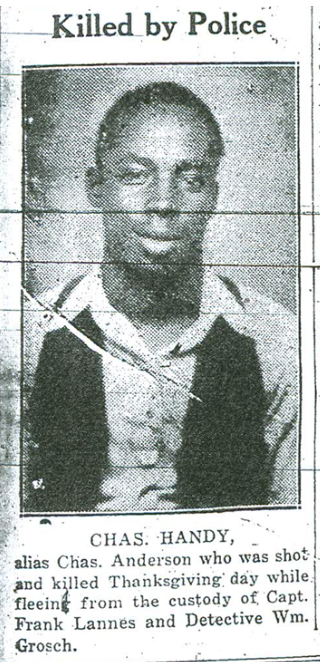
Four months later, on Nov. 24, 1937, Grosch and Lannes sought 17-year-old Black teenager Charles “Handy” Anderson Jr. on accusations that he had attacked multiple white women. The officers discovered him in an alleyway and shot him in the head. According to the Hot Springs New Era, Grosch and Lannes stated that they shot Anderson because he resisted arrest. The Pittsburgh Courier reported that Anderson, “thoroughly searched at the police station,” was unarmed at the time of the incident.
On Christmas Eve that year, Grosch responded to the scene of a fatal shooting. While on the street, he saw John Anderson, a Black teenager, run out of a saloon. Newspapers reported that Grosch allegedly ordered Anderson to stop and began to chase him on foot. At some point, according to reporters, Anderson struck Grosch in the face, causing the detective to fall to the ground. Grosch stated that he thought Anderson was going to kick him, so he fired his gun. Anderson was brought to Charity Hospital, where he was treated for a gunshot wound in his thigh that shattered the bone. He was charged with “assault, beating and wounding Detective Grosch.”
On June 17, 1938, Aaron Boyd Jr., a 39-year-old Black World War I veteran and longshoreman, was discovered dead in a prison cell at the 7th precinct station about four hours after his arrest. Police had pursued Boyd on foot before capturing him and taking him to the precinct. Newspapers reported that Grosch and Lannes arrived as Boyd was being booked — they stated they left the station when they saw “the situation was handled by uniformed men,” highlighting an arrest they made elsewhere at 11 p.m. as an alibi. Following an internal investigation, Grosch’s brother, John, announced on June 21 that Boyd “received his most serious injuries when he was on top of a fence… trying to make an escape,” and during a “scuffle” with two patrolmen during transport to the precinct.
Just a month later, William Grosch was one of five officers charged with assault, battery, and kidnapping for their July 7 response to a Congress of Industrial Organizations (CIO)-led taxicab strike. Newspapers reported that two individuals were shot and 86 arrested during the police “raid” on strikers. CIO organizers Bert Nelson, J. R. Robertson, and Felix Siren filed affidavits claiming they were beaten, held, and threatened. Judge Frank Echezabal called the affidavits “fanciful and bizarre,” and they were dismissed.
The following year, Nelson pursued a $25,000 damages suit against Grosch and four other officers. He stated that he had been arrested without a warrant and held at the 3rd precinct station overnight. The next morning, Nelson said, Grosch and three other officers drove him to Jefferson Parish and “with force of arms and under threat of death,” told him to leave the city. Following a day and a half of testimony, a jury deliberated for 12 minutes on Oct. 24, 1939 before issuing a decision in favor of the police officers.
By November 1941, “third degree tactics” had been dubbed by the Louisiana Weekly as “almost synonymous with the Detective Bureau of the New Orleans Police Department.” Just months after killing Smith, Grosch and his partner, Andrew Arnold, found themselves back in court for forcing three 17-year-olds to confess to a murder. “Wherever there is a questionable killing, the shooting of handcuffed prisoners, the use of the third degree,” the reporters wrote, “look for the ‘killer twins’ and there will be Grosch and Arnold.”
Grosch employed the use of third degree tactics throughout his career and, as far as the records show, was never disciplined or otherwise punished for it. In February 1941 the Chicago Defender reported that, during his hearing before the Recorder’s Judge in Detroit, Smith stated, “I will never be tried by a New Orleans court.” Smith understood what his extradition meant. In fighting to remain in Michigan, he was trying to save his own life.