


Lamar Smith
Lamar Smith was a 63-year-old voting rights activist, farmer, and World War I veteran. He and his wife, Annie, lived in Lincoln County, Mississippi with their two children.
Case summary
Incident
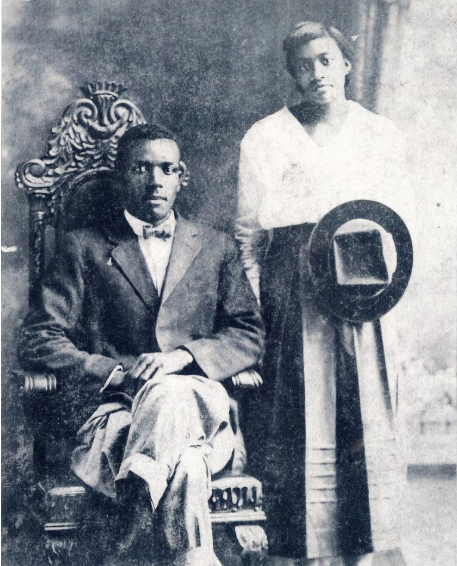
On the morning of Aug. 13, 1955, Lamar “Ditney” Smith arrived at the Lincoln County Courthouse in Brookhaven, Mississippi. An established farmer and a leader in local Black voter registration efforts, Smith was active in the upcoming county supervisor election. He encouraged absentee voting to avoid what the Philadelphia Tribune called “a reign of terror” for Black voters in Mississippi.
Smith’s wife Annie later told the NAACP that her husband’s appearance at the courthouse that morning was planned. When Lamar Smith arrived, there were approximately 20 to 30 people present. One of them was white Lincoln County Sheriff Robert Case.
District Attorney Elisha Barlow told reporters that three white men - Noah Smith, Mack Smith, and Charles Falvey - started arguing with Lamar Smith as soon as he arrived at the square. “They all got into a scrap,” Barlow said, “and one of them finally pulled a gun and shot Smith.” The bullet hit Lamar Smith below his right arm and, according to Barlow, he “ran 22 steps” before collapsing. The three men fled the scene.
Brookhaven Police Chief Clyde Coker’s statement to the FBI differed from Barlow’s account. Coker stated the white men were arguing with Smith that morning “because of his illegal manipulation of votes,” alleging that Smith had been “selling Negro absentee votes to one faction in a supervisor’s race.” Coker said he arrived at the scene just after the shooting, finding a pistol and $35 in Smith’s pocket.
Several newspapers reported that the only items discovered on Smith’s person were absentee voting pamphlets.
Smith was pronounced dead at the courthouse at 11 a.m.
Aftermath
Case called the FBI the day of the shooting to inform them of Smith’s death. In a letter to the FBI’s New Orleans field office, Bureau Director J. Edgar Hoover summarized that Case had “advised that the victim had been active in urging and assisting negroes to register for voting in Lincoln County and felt that possibly a complaint would be made to the Bureau that the victim’s civil rights were violated.” Case told the FBI that an “examination of the victim’s body” revealed unconfirmed evidence that Smith had been “in a fight prior to the shooting.” The sheriff said the shooter’s identity was unknown.
The next day, Case arrested 58-year-old farmer Noah Smith. In a signed statement to the press, Barlow, the district attorney, stated, “Sheriff Case told me he saw Noah Smith leave the scene of the killing with blood all over him,” but “made no effort to pick him up after being requested to do so by me until I signed an affidavit and had Judge [E.F.] Allen issue a warrant.”
On Aug. 16, a coroner’s jury convened for four hours and heard from 12 witnesses before determining that Smith died as a result of a gunshot wound following an “altercation” with Noah Smith, Mack Smith, Falvey, and “perhaps other parties unknown at this time.”
Police arrested Mack Smith, a 45-year-old oil field worker, and Charles Falvey, a 31-year-old farmer, following the inquest.
On Aug. 17 the Smiths and Falvey posted their respective $20,000 bonds and were released from jail. All three waived their preliminary hearings and awaited the September sitting of the Lincoln County grand jury.
In the days following Lamar Smith’s death, citizens of Lincoln County began organizing a petition to urge Gov. Hugh White to protect Black voters in the upcoming election by deploying the National Guard. White told reporters that the “sheriff and his deputies can handle any situation that might arise in Brookhaven” and said he did not plan to take further action.
On Aug. 19, NAACP Special Counsel Thurgood Marshall sent a letter to the U.S. attorney general urging a federal investigation into Smith’s killing. He informed the attorney general that Smith “had received several threats on his life if he did not slow down on his political activities.”
A Lincoln County grand jury convened in September 1955 to review Smith’s case. On Sept. 20, the jury declined to indict any of the three men charged with his death. Their statement read, in part:
This grand jury has been unable to get evidence sufficient to make out a case of either murder or manslaughter. … People standing within 20 or 30 feet at the time claim to know nothing about it, and most assuredly somebody has done a good job of trying to cover up the evidence in this case and trying to prevent the parties guilty therefor[e] from being brought to justice…
The grand jury recommended further investigation. Barlow agreed but, as several newspapers reported, he decried the failure to indict anyone as a “gross miscarriage of justice.”
The FBI continued to monitor Smith’s case, contacting newly-sworn-in District Attorney Mike Carr about it in January 1956. Hoover updated Olney in February, commenting that Carr was “interested in seeing justice done in this case.” According to Hoover, Carr had "subpoenaed several witnesses before a grand jury” in a “secret hearing” at the end of January, but no indictments resulted.
A Sep. 14, 1956 report from the FBI’s New Orleans office stated that a grand jury convened that month but “heard no witnesses in the case and conducted no additional investigation.”
The FBI continued to periodically check in with the district attorney’s office until May 1957. An FBI report from May 28 stated that Carr had made “every effort to develop evidence sufficient for prosecution in an effort to clear up this case.” Carr told the FBI that he would keep Smith’s file open, but did not believe prosecution was possible unless some sort of “break” encouraged someone to “furnish information.”
In June 1957, Annie Smith obtained a military headstone for her husband’s grave at Mount Carmel Cemetery in Caseyville.
In January 1958, Carr advised the FBI that there were no new developments in Smith’s case. The Civil Rights Division of the U.S. Department of Justice (DOJ) concluded on Feb. 26: “No further investigation is desired.”
The FBI and DOJ reopened Smith’s case in 2009 pursuant to the Emmett Till Unsolved Civil Rights Crime Act. FBI agents obtained death certificates for Noah Smith, Mack Smith, and Falvey, who died in 1975, 1992, and 1975, respectively.
In April 2009, the FBI contacted several members of Lamar Smith’s family. The family shared that the day before Lamar Smith’s death, Noah Smith, Mack Smith, and Falvey had delivered some whiskey to one of his neighbors, William Pierce. According to the family, Pierce was “instrumental” in convincing Lamar Smith to go to the courthouse the following morning. The family also told the FBI that Lamar Smith was unarmed the day of his death.
Following their interviews with the Smith family, the FBI determined that both Pierce and his wife were deceased.
After contacting local media outlets, state and university repositories, the Southern Poverty Law Center, the Mississippi Branch of the NAACP, and Lincoln County officials, the FBI did not identify information leading to prosecution. In April 2010, the DOJ formally closed Smith’s file, explaining the “federal government cannot prosecute the three identified subjects because they are deceased” and other subjects “have never been identified.”
Media Gallery
Case summaries are compiled using government records and archival primary source material. These include, but are not limited to, investigative records, arrest reports, newspaper articles, court filings, census records, birth and death certificates, transcripts, and press releases. In many cases, the records contain contradictory assertions.
In addition to the incident files associated with this case, this summary relied on the following:
Archival Sources
- Claude A. Barnett Papers; The Associated Negro Press, 1918-1967; Press Releases, Series B: 1944-1955; Chicago Historical Society, Chicago, Illinois
- NAACP Papers: Branch Department Files; Field Staff, Field Secretaries and Directors, Mississippi; Evers, Medgar Wiley, 1955-62; Library of Congress, Washington, D.C.
Genealogical Records
- Headstone Applications for Military Veterans, Mississippi, United States, 1957
- Population Schedule for Lincoln County, Mississippi, United States Federal Census, 1900, 1910, 1920, 1930, 1940, 1950
- U.S. Find a Grave Index, 1971
- World War I Service Cards, Mississippi, United States, 1918
Newspaper Articles
- “3 Freed on Bond in Election Slaying,” The Evening Star (Washington, D.C.), August 18, 1955
- “Barlow Charges Election Fraud All Over Lincoln,” Enterprise-Journal (McComb, MS), August 18, 1955
- “Brookhaven Killing Spotlights Tuesday Voting,” Jackson Advocate (Jackson, MS), August 20, 1955
- “Desegregation Violence Flares: 1 Slain in Mississippi,” The Chicago Defender, August 27, 1955
- “E. C. Barlow, Former District Attorney, Dies,” Enterprise-Journal (McComb, MS), November 29, 1957
- “Grand Jury Recessed Without Indictment in Slaying,” Jackson Advocate (Jackson, MS), September 17, 1955
- “Grand Jury Sees a ‘Cover Up’ in Negro Death Quiz,” The Vicksburg Post (Vicksburg, MS), September 21, 1955
- “Held for Slaying Brookhaven Negro,” Sun Herald (Biloxi, MS), August 15, 1955
- “Hold 3 White Mississippians,” Jet Magazine, September 1, 1955
- “Killing of Negro at Brookhaven is Being Ascribed to ‘Politics’--Three White Men Now Accused,” Enterprise-Journal (McComb, MS), August 17, 1955
- “Lincoln Grand Jury Without Bill in Courtyard Slaying of Negro–Barlow Calls It ‘Cover-Up’ Job,” Enterprise-Journal (McComb, MS), September 21, 1955
- “Lincoln Man Surrenders in Vote Shooting,” Clarion-Ledger (Jackson, MS), August 15, 1955
- “Miss. Officials Try Again in Brookhaven Slaying,” Atlanta Daily World (Atlanta, GA), September 28, 1955
- “No Indictment Returned in Smith Slaying,” Jackson Advocate (Jackson, MS), September 24, 1955
- Obituary for Robert E. Case Sr., Enterprise-Journal (McComb, MS), February 18, 1987
- “Pin Vote Slaying On Trio,” New Pittsburgh Courier, August 27, 1955
- “Press is Banned from Inquest in Death of Negro,” The Vicksburg Post (Vicksburg, MS), August 16, 1955
- “Smith’s Hearing Set This Afternoon,” Clarion-Ledger (Jackson, MS), August 16, 1955
- “Terror Reigns in Mississippi: Address of Dr. T. R. Howard,” Baltimore Afro-American, October 8, 1955
- “Three White Men Charged with Assassination of Political Leader,” Philadelphia Tribune, August 23, 1955
- “Who Slew Negro Leader in Trap,” Jet Magazine, September 1, 1955
- H. Austin Smith, “Not One Witness,” Christian Century, June 6, 1956