


Lynchings, abductions, and fatal shootings among eight new cases just released
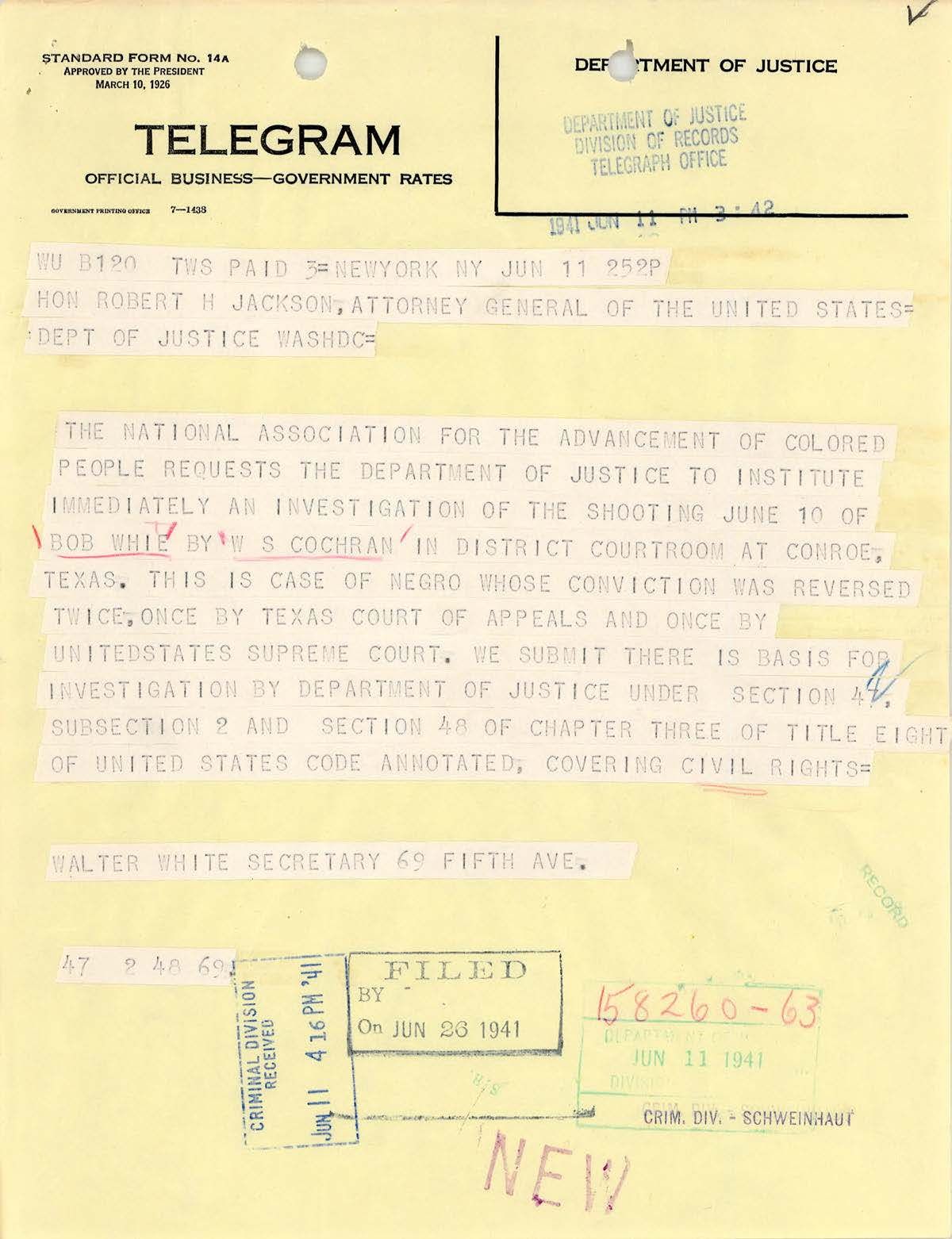
A Black man shot dead in a Texas courtroom. A Florida man who came to be known as “the man who was lynched twice.” An Alabama farmer who was last seen alive being dragged by a mob into a swamp.
These are among eight new cases released this week by the Civil Rights Cold Case Records Review Board, a four-member panel of private citizens tasked by Congress and the President with reviewing and releasing investigative records concerning unsolved and unresolved civil rights violations from the Jim Crow and civil rights eras, between 1940 through 1979.
This week’s release brings to 52 the total number of cases released since October 2024. The latest release adds 3,112 pages of records to the Civil Rights Cold Case Records Portal, a website maintained by the National Archives and where all the records released by the Board can be viewed and downloaded.
The newly released files include the following:
- Bob White was a 28-year-old Black farmworker from Livingston, Texas, whose coerced confession in a 1937 rape of a white woman led the U.S. Supreme Court to rule that his right to due process had been violated. During a new trial in 1941, the local court was entering recess when W.S. Cochran, husband of the alleged rape victim, approached White and shot him in the back of the head. Though Cochran was tried, the prosecutor urged the jury to acquit, which they did – after deliberating two minutes. The gallery erupted in cheers, according to newspaper accounts. The federal government did not investigate.
- A.C. Williams, 20, lived with his mother in Quincy, Florida. Jailed on May 11, 1941, the Black man was accused of assaulting a 12-year-old white girl. The next evening, masked men held a police officer at gunpoint and forced him to release Williams to them. The following day, Williams, suffering numerous bullet wounds, crawled home. Police dispatched an ambulance to transport him to a Black hospital shortly after midnight on May 13. The vehicle was apprehended by masked men who again abducted Williams and, this time, abandoned his deceased body on a bridge. Despite a local inquest and a state investigation, no one was ever charged and the federal government declined to investigate. News accounts referred to Williams as “the man who was lynched twice.”
- Jesse Thornton was a Black farmer in Luverne, Alabama. On June 22, 1940, a Luverne police officer struck Thornton with a blackjack after hearing Thornton reference him by name without saying “Mister” first. As the officer was taking him to jail, Thornton broke free and started running. A mob began chasing him, throwing stones and firing weapons at him. When the mob caught up with Thornton, they put him in a truck, which was seen taking him toward a swamp. His body was discovered six days later, and he was buried before his widow was notified he’d been found. No one was charged.
Summaries of these cases, as well as the five other cases being released this week, can be found on the Board’s website, coldcaserecords.gov. Among the other cases: Willie Vinson, a 31-year-old dish washer in Texas abducted from his hospital room and lynched by a mob outside Texarkana in 1942; Wilmer Smith, a 39-year-old Louisiana man who was in handcuffs when he was shot dead by a New Orleans police detective in 1941 (read more about the detective, William Grosch, here); and Quinzy Hill, a 40-year-old tenant farmer in Texas shot to death by his employer in 1940.
“With each new case the Board releases, a fuller picture emerges of the cruelty and depravity visited on Black Americans by their fellow citizens during the Jim Crow and civil rights eras,” says Hank Klibanoff, Board co-chair. “Whether it was lynch mobs, rogue cops, or a solitary person taking the law into his own hands confident that he’d be protected by his skin color, the effect was the same – racially-motivated killings that went unpunished. While the perpetrators are long dead, we hope these records offer some clarity to the descendants of the victims and also hasten the judgment of history.”
The Civil Rights Cold Case Records Review Board was created as part of the Civil Rights Cold Case Records Collection Act of 2018, which passed Congress with overwhelming bipartisan support and was signed into law by President Trump in 2019. The Board’s work is currently mandated to sunset no later than January 2027. Legislation that would extend the Board’s tenure until 2031 is currently pending before Congress.