


Rogers Hamilton
Rogers Hamilton was an 18-year old farm laborer who supported his mother, Beatrice Hamilton, siblings, nephews, nieces, and cousins following his father's 1955 death. Hamilton had plans to marry right before his death.
Case summary
Incident
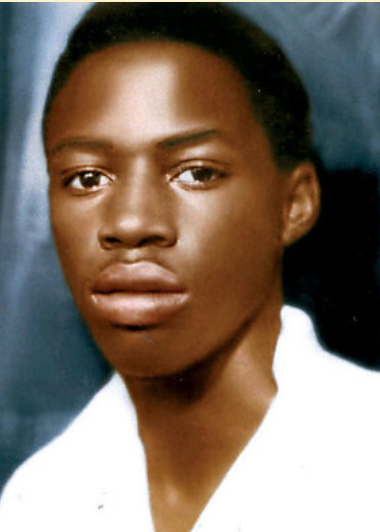
Around 1 a.m. on Oct. 22, 1957, Beatrice Hamilton was in bed in her Lowndes County home when she heard an approaching vehicle and someone calling for her son, 18-year-old Rogers Hamilton. Preston Fields, Rogers Hamilton’s nephew, also heard someone call for Rogers about five times. Beatrice Hamilton told her son to “get up,” thinking that George McCurdy — their white neighbor and Rogers Hamilton's employer — was calling him for early work. After he went outside, she “cracked” open the front door to see and hear.
In an Alabama Department of Public Safety (DPS) interview, Beatrice Hamilton stated she observed Rogers Hamilton and a white man walking to a green truck in the yard and talking for about five minutes. The man placed his hand on her son, they got in the truck, and then drove off.
Against the wishes of her children, Hamilton went outside to follow the truck on foot. When she got to a “cattle gap,” she saw the stopped truck — noting its yellow tag with black numbers — and Rogers Hamilton and a man standing in the road. When the man drew a pistol at her son, Beatrice Hamilton screamed, “Lord, don’t shoot my boy.” The man fired and Rogers Hamilton fell to the ground. According to Beatrice Hamilton, the man drove away towards Alabama Highway 97.
Beatrice Hamilton ran to her son, shining a flashlight on his face, and saw he had been shot in the forehead. She ran to McCurdy’s home around 2 a.m. and asked him to call the sheriff.
Aftermath
Lowndes County Sheriff C. Frank Ryals told FBI agents that “he realized that he and his staff had neither the training nor the ability to properly work such a case” and called Chief of the State Investigation Division T.J. Carlisle for support. Carlisle assigned DPS investigator Oscar F. Coley to the case.
Coley reported to Hayneville on Oct. 23, assisted by Lowndes County Deputy Sheriff Joe Jackson. Coley first interviewed McCurdy, who said he had known Hamilton his whole life and had “never known of him being in any trouble.” McCurdy also said that Beatrice Hamilton stated she did not know who shot her son but disclosed two “white men in a truck had carried him off from the house.”
Coley interviewed Hamilton, who retraced her steps in detail. He wrote in his report that “although sincere in her belief that her statement is true,” Hamilton, “in all probability” was “mistaken in many respects” due to the “emotional upset of her son being killed.” Coley asserted that “she could not possibly have seen” Rogers and the man from where she first saw them, nor could she have been able to tell the man’s race or the color of the truck and the tag in the dark. Coley, unable to determine a motive, submitted a final report on Oct. 25 and referred the investigation back to the Lowndes County sheriff.
Ryals advised the FBI that Coley’s was the sole investigation and that “other than accepting any information that anyone might volunteer,” he did not intend to investigate further. No autopsy was conducted. The death certificate classified the death a homicide, identifying the cause as, “shot by person or persons unknown."
Rogers Hamilton was buried in an unmarked grave at the Baptist Hill Memorial Cemetery Pine Grove Annex on Oct. 28, 1957.
The FBI opened a case file in November and interviewed locals about possible motives and potential leads. Ryals told the FBI that Hamilton was killed either by “a white man due to attention he had been paying to a colored woman with whom the white man is associated,” “a colored man over the attentions of a colored woman,” or “a white man as a result of having waved at a white woman passing in a car.” Ryals disputed reports that the killing was a lynching and told newspapers, “our investigation has revealed nothing that leads us to believe these reports.”
The FBI presented Coley’s report to Assistant U.S. Attorney of the Middle District of Alabama Robert Varner on Nov. 27, 1957. Varner determined that further action was unnecessary because he determined law enforcement was not involved in the killing. He concluded that there was “no indication of a violation of civil rights.”
The Anniston Star reported in 2010 that Beatrice Hamilton claimed that Luck Jackson, a Lowndes County deputy sheriff and brother of Joe Jackson, killed Rogers Hamilton. In the article, her children stated that their mother must have been reluctant to tell Coley, who was accompanied by Joe Jackson. They also shared that McCurdy came to the house the next day and told Beatrice Hamilton “there was little he could do” for the family. Fearful, they fled Alabama shortly after.
Joe Jackson died in 1970, Luck Jackson in 1973, and Ryals in 1996.
Following the Department of Justice (DOJ)’s 2007 Cold Case Initiative and 2008 Emmett Till Unsolved Civil Rights Crime Act, the FBI initiated a reinvestigation of the case on July 7, 2008. Authorities in the Lowndes County Clerk’s office said a fire had destroyed all county records.
The DOJ closed the case on Feb. 10, 2016, concluding that destroyed files and “the lack of identifiable subjects” made a successful prosecution unlikely. FBI reinvestigation records do not indicate an investigation into the family’s claim that Joe or Luck Jackson were responsible for the shooting.
The Alabama Bureau of Investigation also reopened the case in October 2009. On reinterview in 2009, McCurdy noted that he had heard rumors at the time of who may have been involved, but “if I’d known anything then they would have killed me and if I knew anything now they would still kill me.” Investigators noted that McCurdy feared for his safety and would not provide a written or audio statement.
In 2025, news articles revealed possible new context to a previously rumored motive for the shooting. Carolyn Ikenberry (formerly Haigler) told reporters that she and Hulda Coleman, both white, were driving down Highway 97 on Oct. 21, 1957 when they saw Rogers Hamilton walking along the road. Ikenberry said that when Hamilton waved at the car, seemingly attempting to get a ride, Coleman “became visibly upset.” Ikenberry said that Coleman wanted to tell her father, part-time Lowndes County Deputy Sheriff Thomas Coleman Sr. Another friend of the then-teenagers, Bettie Lewis (formerly Wible), shared that Coleman and McCurdy’s cars were similar, and Hamilton may have mistaken one for the other.
In a 2025 AL Reporter article, family members recalled a group of white men encircling the house shortly after Hamilton’s killing. Elizabeth Welch, Rogers Hamilton’s niece, stated, “Klansmen were running to windows and looking in and hollering.” The men left when Beatrice Hamilton returned with her sister and brother-in-law. Afterwards, an ambulance came and pronounced Rogers Hamilton dead. The family held a funeral at Baptist Hill Church and arranged to bury Hamilton at the Haynesville cemetery where his father was buried, but sheriff’s department members and townspeople prevented them from entering.
Every two years, the Hamilton family gathers for reunions to remember Rogers Hamilton. Elizabeth Bell, his older sister, told a reporter in 2025: “I think about my brother every single day. … That took a toll on me, it took a toll on all of us, all those years without him.”
Media Gallery
Case summaries are compiled using government records and archival primary source material. These include, but are not limited to, investigative records, arrest reports, newspaper articles, court filings, census records, birth and death certificates, transcripts, and press releases. In many cases, the records contain contradictory assertions.
In addition to the incident files associated with this case, this summary relied on the following:
Genealogical Sources
- Alabama Death and Burials Index, 1881-1974, 1957
- Death Certificate for Alabama, United States, Alabama Center for Health Statistics, 1957
- Population Schedule for Lowndes County, Alabama, United States Federal Census, 1920, 1930, 1940, 1950
Newspaper Articles
- “17-Year Old Boy Lynched in Ala.,” The Louisville Defender (Louisville, KY), November 14, 1957
- “Alabama Boy, 17, Taken from Home by Mob, Lynched!,” Pittsburgh Courier (Pittsburgh, PA), November 9, 1957
- “Ala. Whites Kill Negro Teen,” Jet Magazine, November 7, 1957
- “Another Till Case in Alabama Town?” The St. Louis Argus (St. Louis, MO), November 8, 1957
- “Burned Building with Lowndes County Records Uninsured,” WSFA, March 2, 2006
- “Crime Element: Man Against Man,” The Afro-American (Baltimore, MD), November 23, 1957
- “Gun Victim not Lynched Says Sheriff,” Afro-American (Baltimore, MD), November 23, 1957
- “Gunfights, Floggin, Lynching Mark Ala. Wave of Violence,” The Louisiana Weekly (New Orleans, LA), November 23, 1957
- “Lowndes Ex-Deputy Dies at 86,” The Montgomery Advertiser (Montgomery, AL), June 15, 1997
- “Lynching or Murder?,” New Pittsburgh Courier (Pittsburgh, PA), November 30, 1957
- “Negro’s Death ‘Not Lynching’,” The Anniston Star (Anniston, AL), November 15, 1957
- Obituary for John Henry (Luck) Jackson, The Montgomery Advertiser (Montgomery, AL), December 16, 1973
- Obituary for Joseph Edwin Jackson, Alabama Journal (Montgomery, AL), March 26, 1970
- “Racists Murder 2 Negro Boys,” Arizona Sun (Phoenix, AZ), December 5, 1957
- “Return, Ten-Fold,” The St. Louis Argus (St. Louis, MO), November 8, 1957
- “Rogers Hamilton, 18 Mysteriously Killed,” Atlanta Daily World, November 2, 1957
- “Sheriff Denies Negro Victim of Lynch Mob,” The Montgomery Advertiser (Montgomery, AL), November 14, 1957
- “Sheriff Says Ala. Boy’s Death Not Lynching,” Jet Magazine, December 5, 1957
- Deneen L. Brown, “Unsolved and Overlooked: Investigating Cold Cases of the Civil Rights Era,” The Bulletin (Norwich, CT), June 26, 2017
- Ethel Dunbar, “Half the Truth Hasn’t Been Told,” News & Letters, November 1957
- John Fleming, “He Waved at a White Woman in Alabama in 1957, Witness Now Says: His Murder Remains Unsolved,” AL Reporter, January 20, 2025
- John Fleming, “Midnight Visitors,” The Anniston Star (Anniston, AL), December 12, 2010
- John Fleming, “The Deputy Comes Calling,” The Anniston Star (Anniston, AL), December 14, 2010
- John Fleming, “The Short Life of Rogers Hamilton,” The Anniston Star (Anniston, AL), December 12, 2010
- John Fleming, “Voices from a Cleveland Park,” The Anniston Star (Anniston, AL), December 13, 2010
- B. G., “Negro Struggle,” News & Letters, November 1957
- Liz Ryan, “Rogers Hamilton: No Justice for Murdered Black Teen,” Alabama Political Reporter, April 2, 2025